Tuesday, November 12, 2013

Building Gregor's Room

Unique Perspectives


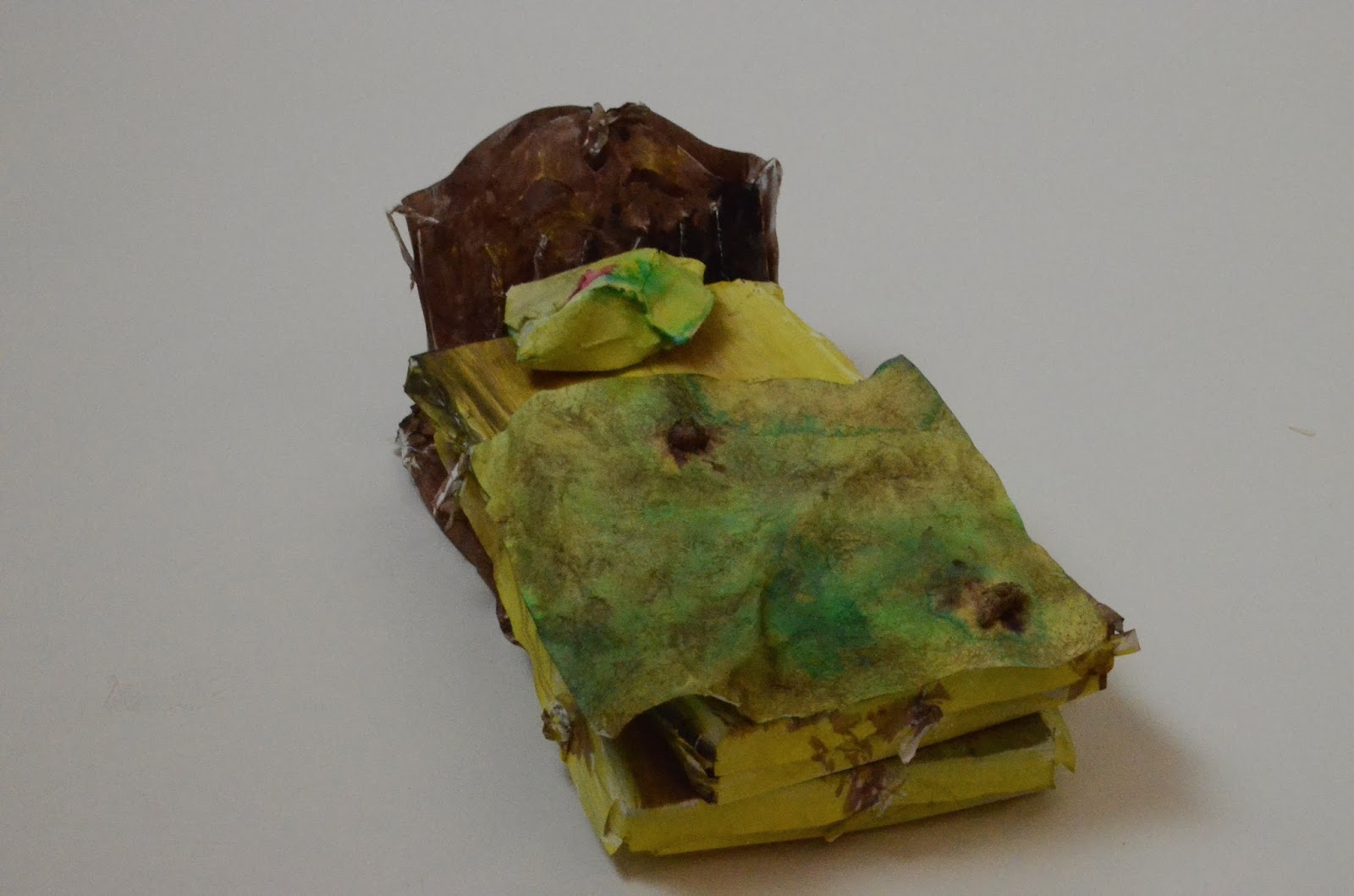
After finishing Kafka's The Metamorphosis, we had to construct Gregor's Room with only copy paper and ink: the bed, Gregor himself, and one other item of our choosing. In class we discussed how we viewed the bedroom and I loved it because everyone's responses were so different. One person imagined the room having a very large window, the blue sky beyond contrasting powerfully with Gregor's imprisonment. Another person saw the space with sharp angles and slanted walls, like an attic room, rather than the average four-wall square. We debated Gregor's size, the meaning of the boarders in the suits, and the texture of the different characters (maybe Gregor's sister is both prickly and smooth, "like an Egyptian mouse" someone said). I felt like I was in a very artsy version of one of my English literature classes.    

One reason The Metamorphosis is such a classic work is because it lends itself to so many interpretations. While reading, we fill in the details Kafka leaves out with our own; though there are clues in the text about the size of Gregor, for instance, his actual situation remains unknown and unquantified. It's like when someone tells a story featuring a relative or professor or classmate you've never seen, and by the end of it, you have a clear image in your head of what this person must look like even though few details were given. Seeing what everyone came up with for their personal "set designs" opened me up to countless new ways of interpreting the text. 

Process Pictures (or lack thereof)


Although I thought I had taken at least a couple w.i.p. pictures, this is the only one I could find from this project. I know I didn't take many because the frustrations of soaking, and baking, and not being able to use adhesives of any sort gave me a one-track mind: GET THIS THING DONE. In this photo, however, you can see the tubes I created to stuff inside the mattress and box spring. I gave them so much detail because my plan was to rip the mattress and box spring to reveal the structure underneath, giving it a "bare bones" feeling. To the far right, you can also see the Tupperware container where I soaked my paper overnight.


Final Pieces
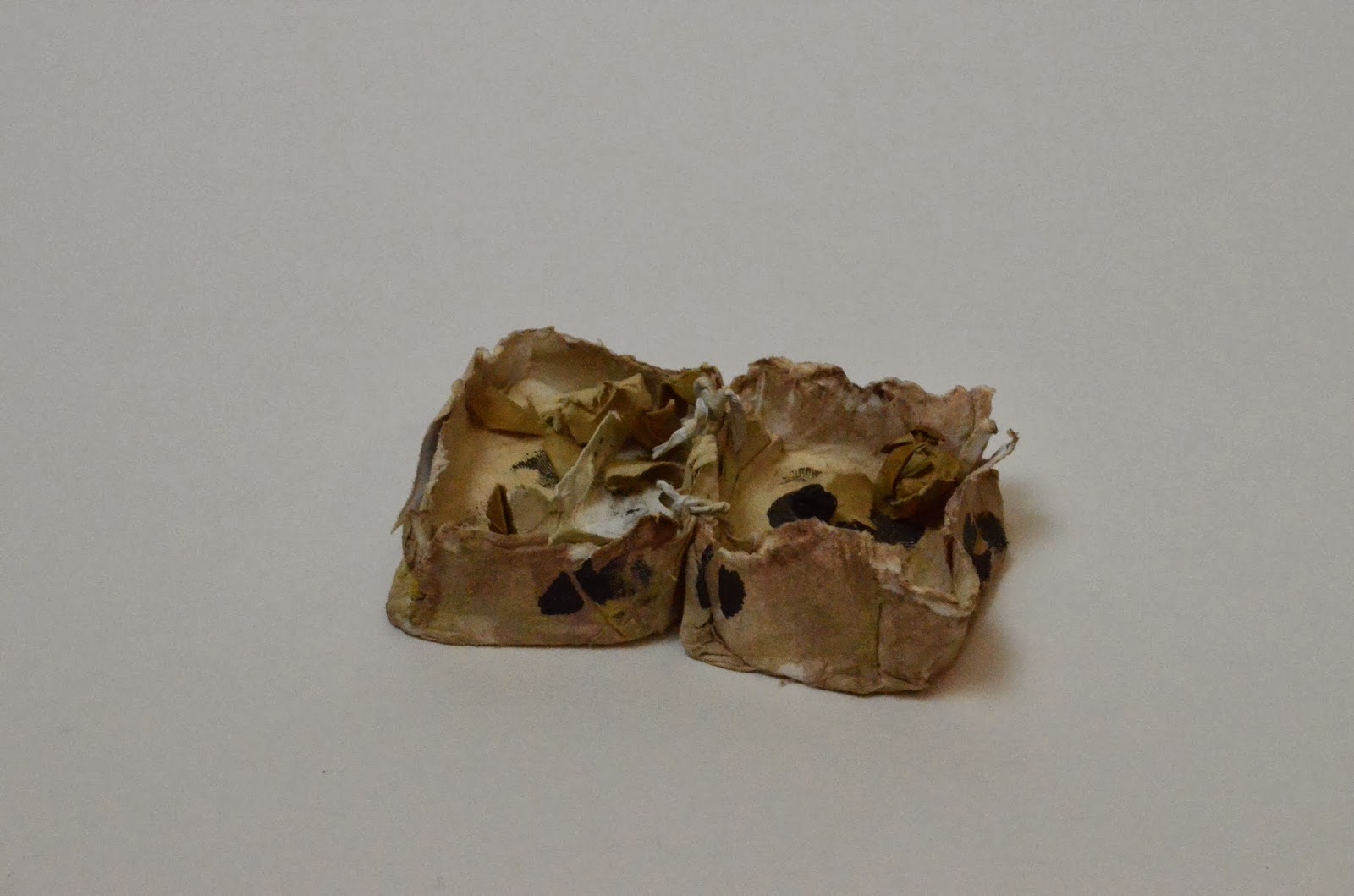

Gregor


Gregor's Bed


The violin

At the beginning of the story, Gregor's room seems to be a neatly structured space; after his transformation, however, I imagine the room speedily denigrating into a dirty, tattered, virtually unlivable place. One reading of Kafka's story is that Gregor is mentally ill, that his world is and will forever be colored by that fateful morning when he "turns" into a bug. I wanted my pieces to reflect Gregor's deteriorating mindscape, so I used bright colors mixed with dull ones to indicate confusion, ties to hold things precariously together, and animalistic elements - blood, feces, and prints - to accent the very real, very dehumanizing aspects of mental illness.

While my first instinct was to create a bug-like creature to represent Gregor, the more I thought about it, the more I realized I saw his character as a lack rather than a tangible form. I constructed Gregor's briefcase, the one he would have taken with him to work had he woken up human, and made it into something grotesque. The edges are sharp, the inside littered with garbage, and the outside marked by black fingerprints and brown stains. A small black ball is, so to speak, Gregor's "essence" - the shrinking of his mind and soul into something so tiny and insignificant it could easily disappear, never to be found again (as it did when my project fell down the stairs at my apartment!). I also held the two compartments of the briefcase together with my homemade "twine," a motif which carried over during my construction of the bed.

As I mentioned earlier, I imagined Gregor's room to be a very disgusting space. On his too-small blanket (whose size represents the comically pathetic distortion of life caused by mental distress) I attached pieces of poo through a careful method of wrapping in wet paper strips and then securing with two paper fasteners on the other side of the blanket. In order to created the box spring and the mattresses, I both folded the paper and secured the forms with my twine. 

The notion of everything falling apart and away from each other guided my project. For the piece of my choosing, I decided to construct Gregor's sister's violin. I found this object to be so significant because it is his sister's music that draws Gregor out of the darkness and into the family room where his mother, father, and boarders listen to her play. Music is an undeniably powerful force - maybe it's what makes us human. Even the violin, however, becomes a source of oppression for Gregor. Although it is beautiful, it is still grotesque. I soaked the strips of paper in tea and stuck an errant string into the top of the violin. Like a body itself, the violin has a long, parched neck and a wound on its bottom. Its curves have become rough, and its backside is similarly coming undone.

Assembling the Bed


A place that can comfort.
Or destroy.


Like Father, Like Daughter: A Memento

An Introduction

I have been very negligent in my blog duties, so I have a lot of catching up to do. The first project I will tackle is "Memento" from early October. Our assignment was to create a small item representative of a certain memory using only three materials. As I thought about what to do, memories of all shapes and sizes came flooding back to me: reading dinosaur books on the plush beanbags of the tiny library's children's section; listening to "Head Over Heels" by Tears for Fears on the long car trip to Washington D.C.; tornado sirens at Grandma and Grandpa's house during the summer; the sweet, sick, wavy feeling of breaking my arm on the wood floor at dance; making houses in the backyard out of cardboard leftover from the packaging of large appliances. One after another, they surfaced and vanished like carbonation in a freshly-poured glass of pop. After much consideration, I finally latched on to one specific memory: spending time at Howell Airport with my dad.

Aviation has always been a huge part of my life. My dad is a freight pilot and a flight instructor. He was also an aerobatic champion, competing for a spot on the world team, until my sister and I were born. An advocate of "do what you love, love what you do," my dad always says he would fly for free, that "getting paid is just a bonus." I remember wearing his captain's hat and regulation UPS tie as he pulled me around the living room on his flight bag before leaving for another week of work. Because he is gone for about half of the year, our relationship sometimes seems slightly out of touch. Nevertheless, my dad has tried very hard to make sure our father/daughter bond remains strong. One such way he has accomplished this has been through (what else?) airplanes.


My dad holds me in the Decathlon while Uncle Karl poses in his aviators

Howell Airport was a small place in New Lenox, southwest of Chicago. My dad used to spend a lot of time there, and he would often take me (and my sister, when she was old enough) with him, especially during the late spring and summer. I distinctly recall the smell of aviation fuel, purple and white cloves that grew on the grass medians between the taxiways, and the mustiness of the hangars. But more than anything, I remember the little office where Cathy, the receptionist, would greet me and take me into Bill Howell's den with the huge, cushy "boss" chair. I would be given a stack of copy paper and the Christmas cookies tin of crayons, left alone to color while my dad talked airplanes and flew with other adults. I loved flying with my dad, but even back then I understood that some parts of his life were his - that it was okay if some things went over my head. And so, I drew pictures of people with hoop earring-adorned cat ears and sucked happily on Runts from the 25-cent candy machine in the lobby.

Process Pictures


I started out by building a structure of balsa wood reminiscent of my dad's aerobatic trophies.


I knew crayons has to be a central component of my memento. I decided to tear the paper off crayons and rip them into small bits.


I glued the crayon paper to the wooden structure with wood glue.


I then added distorted paperclips to the sculpture by piercing the wood and securing them with glue.  


Final Memento


"Like Father, Like Daughter" 


My final solution consisted of a sculpture made of balsa wood, crayon paper, and paperclips. (Glue was also used in its creation, however because it is not visible, it does not count as a material.) I decided to use wood because it reminded me of the unfinished, exposed ceilings of the hangars and the smell of busy buzz saws in Curly's busy workshop. Its vertical orientation alluded to the memory not only being bigger than me, but also it being about the sky, and airplanes, and looking at the world from a distance. The office/art supplies ground the memento, however, and describe the duality I felt between isolation/participation while at the airport. Though I often sat in Mr. Howell's office and colored, my dad also took time to introduce me to the amazing world of aviation. We would go up in the Decathlon, or my uncle's Luscombe, and sometimes he would pretend to fall asleep at the stick and make me fly the plane for a while as I frantically yelled, "Dad! DAD! WAKE UP!" The bent paperclips represent the pathways we carved through the sky, and visually break up the rhythm of the wooden posts. As I mentioned before, the structure resembles my dad's aerobatic trophies, which he now keeps in his office - the "Captain's Den" - next to model airplanes and his retired captain's hats. In this way, my memento is a monument commemorating things lost: my dad gave up competitive aerobatics when he saw one of his friends crash at a competition, leaving behind a wife and two little girls. Howell Airport has also been shut down, demolished, the site now waiting to be developed into a shopping center. 


We are different, my dad and I, but tied together by so many small moments. Wearing his hat and tie, riding on his flight bag, putting the fruit-patterned cushion in the backseat of the Decathlon so my sister and I could see out the window, eating grilled cheese sandwiches at DeLand and watching the skydivers come in, going to Saturday morning Gaggle Flight breakfasts, camping out at Oshkosh, and, most importantly, taking off down the runway at Howell, watching as the buildings and cornfields got smaller and smaller and smaller. And the place where it all began became but a speck below us as we burst through the clouds.     

Wednesday, October 30, 2013

Janine Antoni

To prepare for our soap carving project, we were to watch a segment on artist Janine Antoni, creator of Lick & Lather (1993). I gleaned much from her Art 21 video, as I do from every episode of the series. My art teacher in high school often had us watch Art 21 segments; I actually still have my 10th and 11th grade notes about James Turrell, Mark Bradford, Laylah Ali, Maya Lin, Laurie Anderson, and Pepón Osorio, among others. It's an undeniably wonderful resource for expanding one's knowledge of contemporary artists and practices as well as finding inspiration.


Chocolate, left, and soap, right
"Cleaning the body with the body / Feeding oneself with the body"

Here's what I scribbled while watching Janine Antoni's video: 

  • Stories held in the material
  • The taking apart of things - what things are made of. Taking apart to understand
  • Body as a tool, the maker of experience
  • CLUES
  • Cow drinking from bath - reversal of relationship: breasts and the archetype of the Virgin Mary
  • The importance of "holding"
  • Our distance from the true source of things
  • Submission / absence
  • What is "me-ness"?
  • Chunk from ear that falls off while she washes herself with herself, both sad and beautiful
  • Loving = erasing?
  • The tightrope, the horizon: balance comes from being comfortable with being out of balance
  • Learning leads to learning leads to learning
One thing I love about the Art 21 series is that every episode is, in itself, a work of art. For example, in Antoni's segment, the editors used her found objects rope piece, Moor (2001), to link the episode together. By using images of the rope for transitions, they made the pragmatic and symbolic aspect of the object-to tie or bring things together-an essential part of the video. Moor reminds me why I am a bit of a packrat...I love collecting things and putting them together to create meaning. There's nothing quite like holding an item, especially a personal one, and feeling the electricity of all it's ever meant and will ever mean surge through your body.


Just a small segment of the rope, but it contains so many lives


 "If I don’t have an experience with the object, how can I hope that the viewer will have an experience with the object?" - Antoni

Tuesday, October 22, 2013

Animal Testing: Soap Carving and Form Changing

Soap Carving: An Overview

Besides my patience, the soap carvings project really tested my ability to apply previous problem solving solutions to a new medium. I had never really sculpted seriously before this assignment; though familiar with Play-doh and those coil pots everyone makes in art class on "clay day," subtracting from a form with carving tools proved much more complicated than sculpting (with the ability to add to and easily "fix") a piece. I felt a lot like SpongeBob in the episode "Artists Unknown" when he talks about the process of really knowing one's marble before beginning to work with it.


YOU GOTTA BE THE MARBLE!

Unlike SpongeBob, I'm not sure if I ever really "became" my soap. But one thing is for certain: I will never, ever be able to forget the smell of Fiorentino peony and seaside body bars. 

Professional pictures of my final pieces are forthcoming. Below, however, is the process one of my sculptures underwent to transform into a new object. Miss Laura said, "If it feels wrong, that probably means you should do it." Well, I did it...and let's just say that things got pretty nasty.

Creating a New Form: Addition and Subtraction


I started out with this lumpy critter as my animal form.


I then grated the tiger's head and tail. (Subtraction) 


This resulted in a pile of soap shavings, which I then scooped into a Ziploc bag, mixed with purple ink, and put in the freezer (depicted below). 


Because I had grated off the tiger's tail, the stick that held it to the tiger's body was no longer necessary. So I used the extraneous stick to poke holes all over the tiger's body. (Subtraction)


Going along my concept, which I will explain later in greater detail, I tried to use mostly cosmetic/bathroom products. Consequently, I covered the tiger with Crest toothpaste. (Addition)


I then stuck the tiger in the oven at 400 degrees for 20 minutes. I felt really bad about it, but it had to be done. (Subtraction/Addition)


While the tiger baked, I created a simple form of tiny Dixie cups (used for water, mouthwash, etc.).  


This is when things started to get stinky. A strange, clinical odor emanated from the oven, especially in the last few minutes of the baking process. It smelled like a dentist's office, but one where something was definitely amiss. The toothpaste had bubbled and formed a crusty layer over the soap.


I then cut the tiger into three pieces (Subtraction)


As if things didn't already stink enough, I decided to add lip gloss to the mix. Using the cosmetic like glue, I put the pieces back together. (Addition)


Then came my worst/best idea: to microwave the tiger on high for 1 minute. I stopped at about :40 because the microwave started smoking and it smelled really, really horrible. However, after letting it rest for a bit, I was able to finish the minute. (Subtraction/Addition) 


The odor of the hot, mutated soap/toothpaste/lip gloss nearly made me puke at least four times after taking it out of the microwave.


While trying not to vom, I scooped the fluffy mush into the Dixie cups (pictured below). (Addition) I also discarded the material that did not fit into the cup structure. (Subtraction)


I then stuck Q-Tips into the mixture. (At this point, everything smelled so bad that I slowly felt my body shutting down.) (Addition)   


After placing the form in an aluminum baking pan, I took the inked shavings out of the freezer and sprinkled it over top the whole thing. (Addition)


FINALLY...


"Animal Testing" 


Sunday, October 6, 2013

Elements and Principles in 3D Form

The first project of my 3D Design career challenged me both conceptually and materially. We were to use only balsa wood, masking tape, wood glue, straight pins, and clear tape to create four sculptures, each representative of a specific element or principle of design. Although every material need not be present in each sculpture, all had to be utilized at least once in the span of our collection.

Sculpture 1: Pattern 
"I Had This Argument Before"


       In my first sculpture, I portrayed the principle of pattern using balsa wood, masking tape, and straight pins. The w.i.p. photo to the left shows the painstaking process to which I subjected myself in order to create a controlled visual experience: loops of tape with the sticky side facing outwards. I create two layers of loops, careful not to crush the delicate "underloop" layer as I added the second on top, and then raised the square platform with loop-encased pins to structurally continue the motif. I added pins in a careful pattern to the top loops, giving further unity and texture to the sculpture. The myriad loops contrast strikingly with the flat "oneness" of the square plane on which they rest. While the visual experience is thus expected, it is rewardingly so; I have to admit, it's a lot of fun to look through the negative space the loops create as light dapples through. One thing I wish I had fixed, however, is the spacing on the left side of the sculpture. With slightly too much wood and not enough tape, it looks a little unbalanced, which in turn throws off the regularity of the pattern I tried to build. Proper measuring (and, in turn, patience) is something I still need to work on - too much of the time I just cut without consulting my ruler first.   


Sculpture 2: Scale
"Planets"


       For my second sculpture, I played with notions of scale by creating clear tape balls of different sizes and placing them in a somewhat surreal, cosmic setting. I am not a sci-fi fan by any means, and my sister and I always made fun (lovingly, of course) of Denny's space-themed kid's menu (Galactic grapes! Space Cadet mac 'n' cheese!), however I really like the spindly, rover-esque legs supporting the main platform of the sculpture. I trapped wood shavings and other bits and pieces littering my cutting board in the tape balls. I then decided to add a strange, tape-based offshoot perpendicular to the taller balsa wood platform. I used wood glue to create a goopy, yellowish mess dripping from the upper platform to the tape mat, and continued making tape balls of different sizes to place on this lower platform. I also trapped glue between the pieces of tape, playing with actual and intangible texture. Overall, the design does not overwhelm my emphasis of scale, however its main flaw is in its flimsiness - I should have reinforced the bottom platform with a piece of wood underneath. Nevertheless, I am happy with my final result. It's out of this world! 


Sculpture 3: Texture
"Our Home" 


     Texture is one of my favorite elements of design. In my third sculpture, I wanted to build a small, secure space in which all different textures were able to manifest. I first created a structure of wood, which I then wrapped with masking tape. I twisted the tape to become an unorthodox type of yarn and wove it around and around the wood base, thereby creating a sort of rug-like wreath. (It actually reminds me of the old yet hearty rug underneath the table in my grandma and grandma's kitchen.) The contrast between the wood grain and the "woven" tape is lovely, but I decided to push it further by adding an adjacent piece of wood - this one torn up and gouged by my knife. I added a clear piece of tape to the back of the main square "wall," a pile of tape "garbage" in the corner, and two little needle-like wood pieces on top of the pit-marked wood chunk. Piercing the wood with the pin was strangely satisfying and somewhat therapeutic. Then it started reminding me too much of skin, and I started feeling a little sickly. Although the piece is complicated by its different textures, I believe it retains an important sense of unity. Eyes move around the piece harmoniously and in all directions. 


Sculpture 4: Focal Point
"Alabanza" 

For my final sculpture, I decided to work with focal point. I knew I wanted to make a vertical statement, so I created a diamond-shaped structure wrapped with clear tape and adorned with pins atop a plain wooden base. By creating a stark contrast between the horizontal and vertical planes of the sculpture, I automatically created a focal point, however I wanted to emphasize it even more. To do so, I added a small hanging piece in the diamond structure, to which I gave some fine detail. I still felt like something was missing, however, which is when I decided to add the straight pins (as seen in the w.i.p. photo below). I bent them with my scissors into a state of praise, and so even their line of sight meets up with the small centerpiece of the diamond. I feel like this piece accomplishes what I set out to do, however I believe the main structure could have been strengthened by better, more concise measurements. Like I said, patience, patience, patience!